Gelatide Official Website › Blog › How much caffeine is in it
How Much Caffeine Is In Gelatide? Nobody Publishes It
Two of the six extracts carry caffeine, guarana seed is denser in it than coffee bean, and no total appears on the label or the sales page. Here is how to bound an unknown.
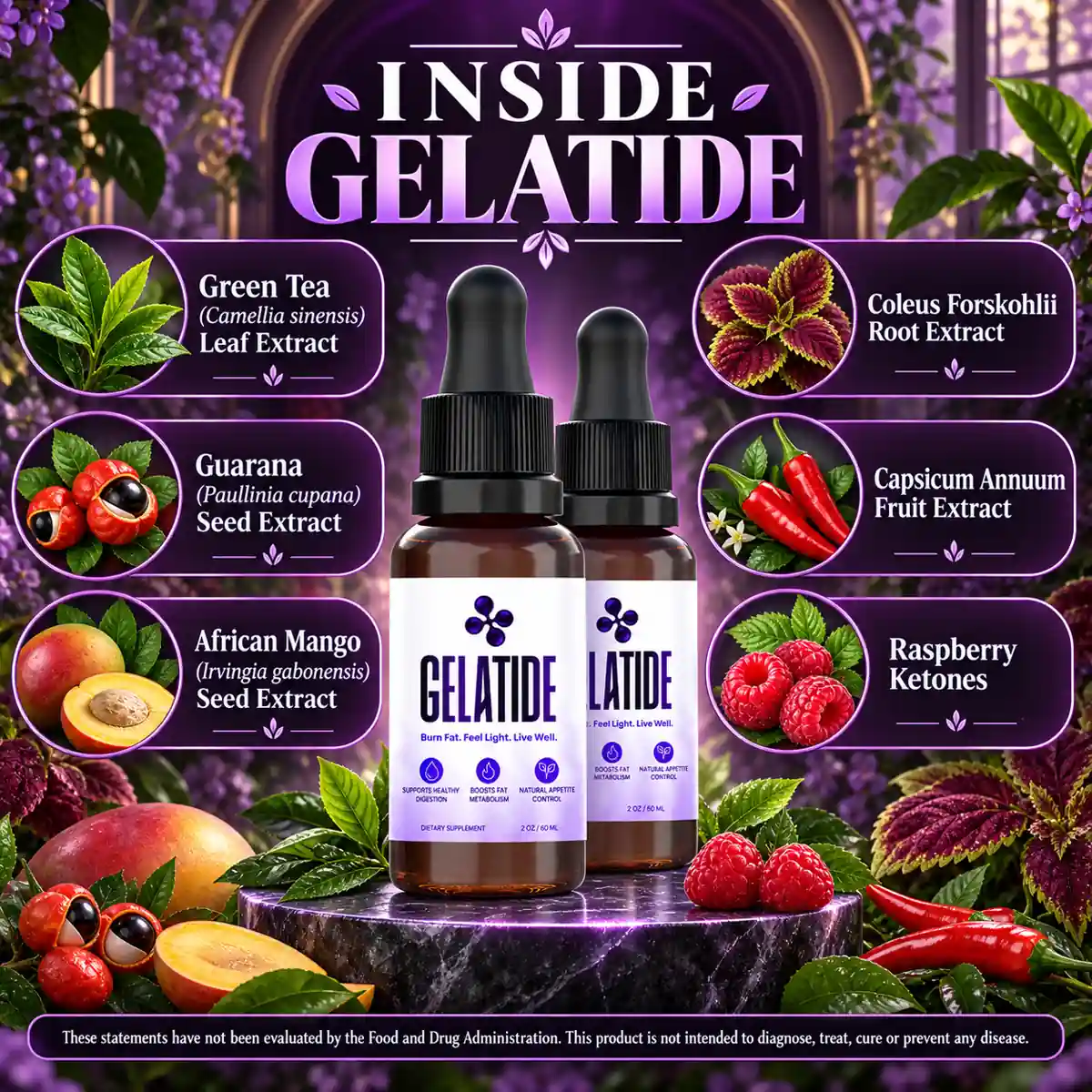
- Two of the six extracts carry caffeine. Green tea leaf and guarana seed, both naturally.
- Guarana seed is denser in caffeine than coffee bean, roughly two to six per cent by weight against about one to two.
- No total is published. Not on the bottle, not on the artwork, not on the sales page. It is the most practically consequential missing number on this label.
- The usual ceiling for healthy adults is 400 mg a day. You cannot add an unknown to that sum.
General information, not medical advice. Gelatide is a dietary supplement for healthy adults aged 18 and over. It is not a drug, it is not FDA-approved, and it is not intended to diagnose, treat, cure or prevent any disease. Two of its six extracts carry caffeine and one of them has a rare association with liver injury, so speak to a doctor or a pharmacist before adding it to anything you have been prescribed. Nothing on this page is a reason to delay seeing somebody about a symptom.
Why caffeine is on a metabolism label at all
Caffeine is the most reliable thermogenic compound available over a counter, and that is not a marketing claim. It raises resting energy expenditure for a few hours after a dose, the effect is dose dependent, and it has been measured repeatedly. The International Society of Sports Nutrition position stand on caffeine-bearing products covers the physiology and the practical limits in detail.
So when a formula wants a mechanism it can stand behind, caffeine is the obvious ingredient. What is less obvious is why it so often arrives under a botanical name. Three reasons, none of them sinister and all of them worth knowing:
- A plant name reads better than a chemical. “Guarana seed extract” sounds botanical in a way “caffeine anhydrous” does not.
- Naturally occurring caffeine does not always have to be declared as caffeine in the way an added isolate would.
- It brings other compounds along. Guarana carries theobromine and theophylline as well, and green tea carries catechins, so the botanical form is not simply a disguised stimulant.
All three are legitimate. The consequence is still that a buyer reading a botanical ingredient list may not realise they are looking at two stimulant sources.
The two sources on this particular label
Gelatide names six extracts. Two of them carry caffeine.
| Extract | Carries caffeine? | Note |
|---|---|---|
| Green tea leaf extract | Yes | Naturally, alongside catechins. The amount depends entirely on the extract specification, which is not published. |
| Guarana seed extract | Yes | Naturally, and densely. Also carries theobromine and theophylline. |
| African mango seed extract | No | |
| Coleus forskohlii root extract | No | Has its own blood pressure conversation instead. |
| Capsicum annuum fruit extract | No | |
| Raspberry ketones | No |
Two of six is not unusual in this category. What is unusual, and what this article is really about, is that the label prints no amount for either of them and no total for the pair.
Why guarana is denser than coffee
Guarana seed is one of the richest natural sources of caffeine there is. Analyses of guarana seed put the methylxanthine content well above that of coffee bean by weight, and the seed also contains theobromine, the compound that makes chocolate mildly stimulating, and theophylline.
Two practical consequences follow. A small quantity of guarana extract can carry a meaningful caffeine dose, so “only a little guarana” is not reassuring without a number. And because the extract is standardised differently by different manufacturers, two products naming the same ingredient can differ several-fold in what they actually deliver.
Guarana has its own LiverTox monograph, which is worth knowing about even though the entry is reassuring on its own terms: it is there because guarana appears in so many combination products that its contribution has to be tracked separately.
The caffeine total is not the only missing number
Six extracts and no amount for any of them. The label page sets out the ten rows a full Supplement Facts panel would carry, and all ten of them are blank.
$49 to $79 a bottle · 60-day money-back window
Order GelatideThe number everybody quotes, and where it comes from
Four hundred milligrams a day is the figure repeated everywhere for healthy adults, and it is worth knowing that it is not an arbitrary round number. A large systematic review of caffeine's potential adverse effects examined acute toxicity, cardiovascular effects, bone health, behaviour, development and reproduction across healthy adults, pregnant women, adolescents and children, and concluded that the evidence supported that intake for healthy adults without an increased risk across those outcomes.
MedlinePlus is the plainest consumer-level summary of the same territory, and it is a better first read than any supplement page, including this one.
| Item | Typical caffeine |
|---|---|
| Brewed coffee, 8 oz | about 95 mg |
| Espresso, single | about 63 mg |
| Black tea, 8 oz | about 47 mg |
| Green tea, 8 oz | about 28 mg |
| Cola, 12 oz | about 34 mg |
| Energy drink, 8 oz | about 80 mg, and highly variable |
| A metabolism supplement with two caffeine-bearing extracts | Not published |
The last row is the point of the table. Every other line can be looked up. One cannot.
The practical problem with an unpublished total
People treat a missing number as a small number. That is the mistake, and it is the reason this article exists rather than being a paragraph on the safety page.
A buyer with a three-coffee habit is at roughly 285 mg before breakfast is finished. They add a supplement whose caffeine content could plausibly be anywhere from negligible to a hundred milligrams or more, depending on extract specifications nobody has published. They cannot tell whether they are at 300 or at 400, and the difference is the difference between a normal afternoon and a poor night’s sleep.
NCCIH's page on green tea makes the same general point about concentrated extracts: the preparation matters, and a botanical name on its own does not tell you what you are taking.
How to count your day when one item is unknown
You cannot calculate an unknown, but you can bound it. Four steps, and they are the ones this desk would actually follow.
- Total everything you can look up for a normal week. Coffee, tea, cola, energy drinks, pre-workout, chocolate.
- Assume the supplement is a meaningful contributor rather than a negligible one. You have no evidence either way, and the conservative assumption is the cheap one.
- Leave headroom. If your countable total is already above about 300 mg, the sensible move is to reduce something you can measure before adding something you cannot.
- Take it early and hold the time constant. A morning serving keeps whatever it contains away from your sleep, and a fixed time makes any effect easier to attribute.
What too much looks like
The signs are unremarkable, which is exactly why people miss them for weeks and blame something else.
- Jitteriness or a fine tremor in the hands
- A racing or pounding heartbeat
- Anxiety, or a familiar anxiety that has become sharper
- Headache, particularly in the late afternoon
- Sleep that gets shorter without getting lighter
- Stomach upset, which caffeine can cause independently of the capsicum on this label
If any of these appear in the first fortnight, the arithmetic of your whole day is the first place to look, before you conclude anything about the product specifically. The routine page suggests counting your other caffeine for the first week for exactly this reason.
Who should not be doing this arithmetic at all
For some readers the answer is not a smaller total, it is none.
- Anyone pregnant or nursing. Caffeine advice in pregnancy is considerably tighter, and none of these extracts has been established as safe.
- Anyone under 18. The label says adults, and that is the end of it.
- Anyone taking a stimulant medication, including for ADHD.
- Anyone with an arrhythmia or another cardiac diagnosis, where the right person to ask is a cardiologist rather than a website.
- Anyone whose sleep is already the problem they are trying to solve. Adding an unquantified stimulant to that is working against yourself.
The suitability page carries the fuller list, and the second column on it is longer than the first.
The verdict
Caffeine is the most defensible thing on this label and the least disclosed. It arrives from two of six extracts, guarana is denser in it than coffee bean, and the total appears nowhere. For a buyer with a modest caffeine habit that is an annoyance. For a buyer already close to the usual ceiling it is a practical safety problem, because you cannot manage a total that includes an unknown.
The fix a manufacturer could apply is one line on a label: total caffeine per serving. It is on the list of four documents that would move this product from take-it-on-trust to checkable, and it is the cheapest of the four.
Sources cited in this article
- Wikoff D, Welsh BT, Henderson R, et al. Systematic review of the potential adverse effects of caffeine consumption in healthy adults, pregnant women, adolescents, and children. Food Chem Toxicol. 2017;109(Pt 1):585-648. https://pubmed.ncbi.nlm.nih.gov/28438661/
- Jagim AR, Harty PS, Tinsley GM, et al. International Society of Sports Nutrition position stand: energy drinks and energy shots. J Int Soc Sports Nutr. 2023;20(1):2171314. https://pubmed.ncbi.nlm.nih.gov/36862943/
- MedlinePlus. Caffeine. U.S. National Library of Medicine. https://medlineplus.gov/caffeine.html
- da Silva Junior ALS, Ribeiro RA, de Souza JG, et al. Methylxanthine and flavonoid contents from guarana seeds (Paullinia cupana): comparison of different drying techniques and effects of UV radiation. Int J Food Sci. 2024;2024:6660517. https://pubmed.ncbi.nlm.nih.gov/38984058/
- National Center for Complementary and Integrative Health. Green Tea. https://www.nccih.nih.gov/health/green-tea
- LiverTox: Clinical and Research Information on Drug-Induced Liver Injury. Guarana. National Institute of Diabetes and Digestive and Kidney Diseases, Bethesda MD. https://www.ncbi.nlm.nih.gov/books/NBK589113/

Every page, every journal post, the bottle facts and the ingredients go through review by Dr. Goldwyn Foggie (Dr. Goldie), MD before they ship. We write from the printed Gelatide bottle and the seller’s own listing artwork, cite public research beside the amount that research actually used, and print “not published” wherever a figure is not disclosed rather than estimating it. This label names six botanical extracts and publishes no amount for any of them, and that fact appears in every article that names one. Corrections are made on the page itself and the review date moves forward. Write to [email protected]. Last updated September 17, 2026.